Tuesday, 16 November 2010

If you want to help financially please read on

Money isn't everything, but neither is oxygen.  In other words - we can't do without it!

If, after reading about the work of restoration going on in Looking Town, you wish to contribute towards the cost of some of our projects, please donate to our general fund via the Links International Site.

http://www.linksinternational.org.uk/Give.html
Please make payments to the Links International Projects account, and mention Sierra Leone or our ref: 3030   and if you are able to gift aid your donation a form can be downloaded from the site.

Our grateful thanks to the many people who do support us already.

Goodbye to the old clinic

Earlier in the year our team were looking forward to visitng the clinic that NEEDEP had set up.


It was doing useful work, but in a far from ideal environment which the leadership agreed did not reflect the standards that are needed.
The somewhat dark and cramped entrance lobby lead into a room with a couple of beds, a table and chair.


No glass in the window and for post-operative care,  a good scrub with disinfectant would be in order.


Not quite sure what we have here. Medicines, yes. Rubber gloves, radio, exercise book, fish head? Is this where operations are carried out?   

We did meet a couple of people down from the provinces who had had their appendices taken out.  Both appeared to be doing well.  The clinic is continuing to run, but no longer under the name of NEEDEP, who are hoping to establish a new teaching health centre in the new building.

Wednesday, 29 September 2010

New Building is starting to take shape!

I am delighted that walls are now going up at the new building which will give much needed extra classroom space and has the potential to also have a health education room/clinic.  For too long the building site has stood with the building blocks ready and waiting.

Now those blocks are in place and it is looking much better.
We now await concrete for the roofing of this building and to provide a floor for a second storey.  The completed building should look like this:

Friday, 2 July 2010

What it there to see in Freetown?

We did our best to let the team see something of central Freetown on our last full day.

If you know the area, you may have suggestions of other places to visit, but for us the first stop was the Museum, officially closed as it was Saturday, but a kind curator agreed to let us in! It contains many items associated with local culture and the history of Freetown.


A picture of Freetown in 1792 with the Cotton Tree in the centre. The Cotton Tree is an historic symbol of the city.  On March 11, 1792, Nova Scotian settlers landed on the shoreline and walked up to a giant tree just above the bay and held a thanksgiving service there, gathering around the tree in a large group and praying and singing hymns to thank God for their deliverance to a free land. The land was dedicated and christened 'Free Town' according to the instructions of the Sierra Leone Company Directors.

Many believe that the present Cotton Tree is the site where this happened.

The Cotton Tree today.


Alpha Kargbo next to a model of Bai Bureh, a man many believe to have been the greatest leader in the history of Sierra Leone. He was the chief of the Loko tribe to which Alpha belongs. Bai Bureh (February 15, 1840 – August 24, 1908) was a ruler and military strategist who led the Temne uprising against British rule in 1898 in the Northern part of the country. A gifted man with many admirable qualities, he deserves a separate mention in the blog. We shall leave the museum here and move up the hill to the British Council.


Approaching the British Council building. Was it open? Well at least the bit producing light refreshments was, which is what we wanted.


Very British! Enjoying a cup of tea. The British Council's remit is "to build mutually beneficial cultural and educational relationships between the United Kingdom and other countries, and increase appreciation of the United Kingdom’s creative ideas and achievements."

Then on to the Big Market in Wallace Johnson Street. A large building which is home to numerous sellers of local arts and crafts. Unfortunately the ratio of sellers to tourists is not in the traders favour, after all I understand that last year the country attracted only 5000 tourists. Therefore a buyer is the subject of many people's attention and it can be rather unpleasant.  In spite of this many of us were able to buy some attractive objects. Anne Marie was very satisfied with her dress.


Check out this clip for a tour of the market and a view of many of the items on sale.

Across the road from the market is the coolness and calm of St. George's Cathedral, completed in 1828 for the  Church Mission Society Anglican. 
It was the main centre of the religious life of the colony and the memorials show the difficult conditions that were encountered before the discovery of quinine in the fight against malaria. Here are two of them.
Sacred to the memory of Robert Corley, RAC Corps, who survived the Battle of Waterloo and perished in this unhealthy climate, June 16th 1837, in the 39th year of his age.

This memorial was erected at the desire of the afflicted parents of John Mansfield, mate aboard HMS The Scout, in token of their untimely and irreparable loss from the effects of a season sickly beyond example, in a climate pre-eminently fatal to the health and life of Europeans. May 6th 1833.

The Queen attended a Thanksgiving Service in the Cathedral to mark the Independence of Sierra Leone in 1961, and left her signature in the visitors' book.


Then to the beach. We have been there before in past posts - but it is always worth it.

Lumley Beach

The end of a perfect day, and for Sam and Susie, the week was to be the start of a new and growing relationship! Congratulations and Best Wishes for the future. The photo I liked best of you is


Tuesday, 22 June 2010

Good times from our last visit - with photos! Accommodation.

As we look forward to visiting old friends and seeing what progress is being made in healthcare, probably in February 2011, it is good to look back at some of the good times from the last visit.

We were fortunate in our accommodation. Because the official Foreign and Commonwealth Office advice is not to use the ferry at night, we spent our first night at the Harmony Hotel near the ferry terminal at Tagrin. Well worth it. Good welcome and a very fine meal - fish was fantastic!  Comfortable rooms and air-conditioning so efficient that in my room we woke in the night absolutely freezing! They were also good at getting us an early breakdast for the morning ferry.
Highly recommended. http://www.harmonyhotelsl.com/


Owner Saidu Turay at the front of his hotel


Evening view from the hotel


Waiting for our evening meal - the freshest fish I have tasted!

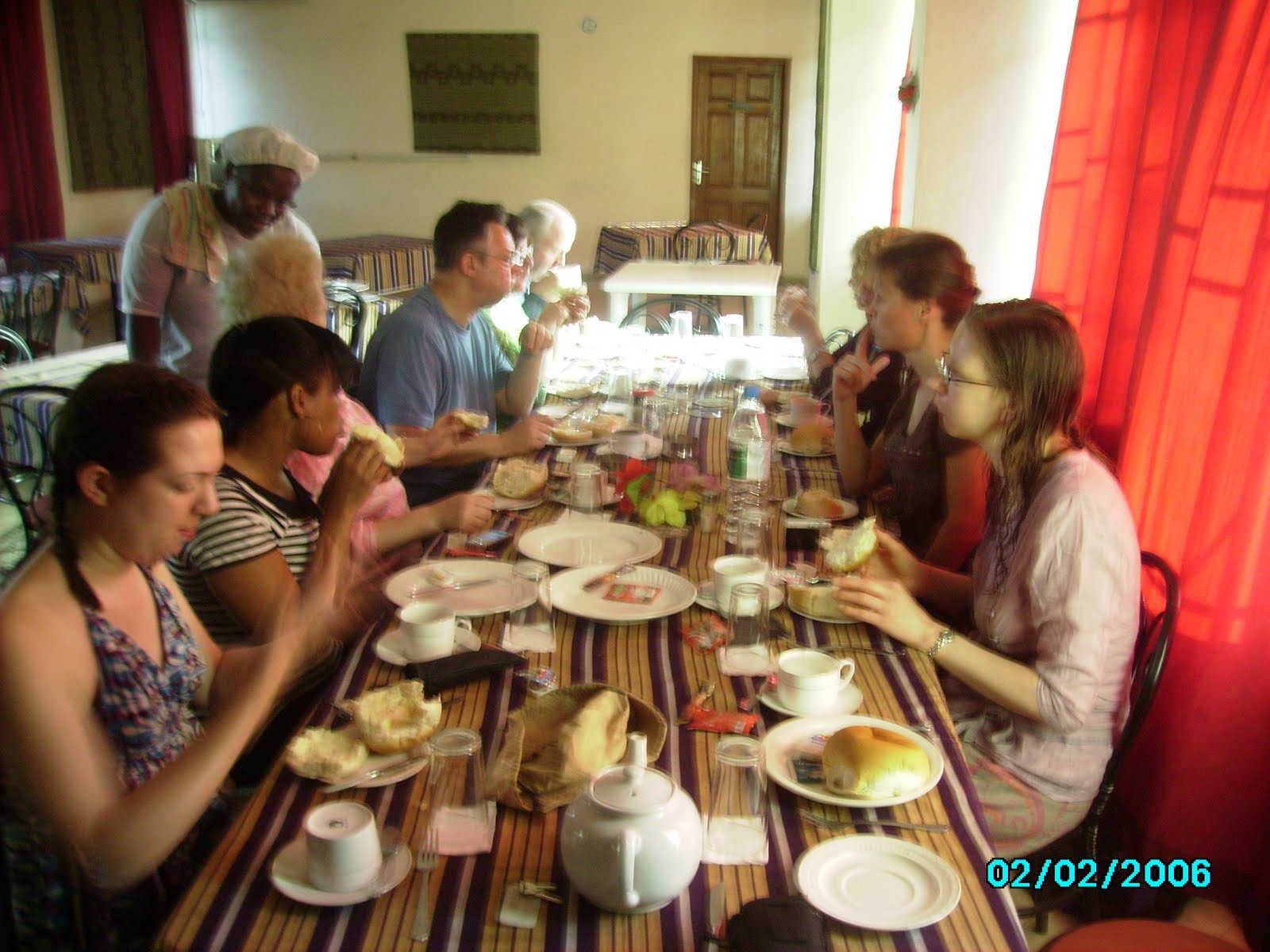
Morning breakfast - not even light yet!


Colourful scene as we wait for the ferry to dock.


Arriving at Freetown after a pleasant crossing.


Hotel 5/10 at Kissy


Getting together in the lounge for morning prayers, afternoon tea or de-briefing in the evening were highlights of the day for all of us. Here are the full team apart from Anne-Marie who took the photo. Ruth is showing only an arm!


The start of every day. Breakfast in Hotel 5/10.

Sunday, 20 June 2010

Some thoughts on Father's Day

Here in the UK it is Father's Day, 20th June 2010.  I have been thinking of my own Father and his influence on my life, particularly in my early days when he often talked about his experiences as a doctor in the Second World War.  As our medical work expands in Sierra Leone, I am sure that if he was still with us, he would be cheering us on. I was aware of a world outside England from the many items he brought home with him - Indian rugs, brass work, pictures, models and (from those less enlightened days) a tiger skin rug and ivory carvings. I was also aware of the distinguished medical career that he had pursued.

In 1940, Alfred Swindale was in North Africa commanding a Field Ambulance, where he had as his Transport Officer Christopher Landon, who later drew on some of his experiences to write a novel, published in 1957, called Ice-Cold in Alex. This was made into the 1958 film which starred John Mills. A recut version of the film, 48 minutes shorter than the original, was released as "Desert Attack" in 1961 in the US.


My Father was then posted to India where towards the end of the war he was responsible for setting up what was then the world's largest hospital. 'The Mail' for Wednesday, 7th February 1945 records a visit by the Viceroy's wife, "Lady Wavell, accompanied by Lieut-General Sir Noel and Lady Beresford Pierce visited the Hospital Town which is under construction at Jalahall, outside the Bangalore Municipal Limits. It is claimed that, when completed, this will be the biggest Hospital in the world with 10,026 beds. ......
Lady Wavell was received by Col. Swindale (Asst. Director of Medical Services) ... and shown around the works completed and in progress."

He then moved to Burma, also as ADMS. I can remember a pennant from the Rangoon Yacht Club hanging up on the wall at home! Finally, I understand that with the acting rank of Major-General, he had overall responsibility for the repatriation of all the Japanese prisoners of war back to the UK through Singapore, including those who worked on the construction of the Burma Railway in 1942–43.


My Father, Alfred Swindale at the time of his investiture 1948


My first visit to London, a city I love, was to go to Buckingham Palace to see him receive the C.B.E. from King George VI. As a small boy, I was mortified that I needed to go to the lavatory in the middle of the ceremony, and encouraged by my Mother, set off past rows of Yeomen of the Guard to be escorted by a tail-coated courtier for a considerable distance to the required room!

However, to return to the topic in hand, I am proud of him and acknowledge the influence that his work, dedication and six and a half years service overseas must have had on me. It is part of my world-view to wish to see good health and prosperity come to those in need of it. Thank you, Dad!

Friday, 18 June 2010

Free Healthcare has come for the under 5s and pregnant and new mothers

You will have seen earlier in the blog that Sierra Leone has some of the world's highest maternal and child death rates.

On 27th of April, Independence Day in Sierra Leone, the President announced that going to the doctor will become free for children under five and pregnant women, and new mothers. The new plan will save lives as many have died because they were unable to pay health service fees and the cost of medication. In a country where life expectancy is 46 (men) and 49 (women), one in eight women risk dying in pregnancy or childbirth, and for every 1,000 children born, 140 die. Indeed it has the highest mortality rate in the world for children under five.

The programme's main donors have been the UN and the UK and there have been some teething troubles.
Ratiszai Ndlovo, Sierra Leone's UN Population Fund representative, told the BBC that although medical equipment had been ordered and some drugs distributed around the country, everything was still not in place at the launch of the healthcare plan.

"It's not perfect, it's not 100%," she said. "But I think we cannot start the programme with everything in a perfect condition."


In this video, Sunkari Conteh describes how her baby died because she could not afford the £15 fee that the doctor who visited her was charging. Although the problem here is seen as poverty, the training that our healthcare team provided in March could have shown how the problem could be solved without outside medical involvement.

Other problems in making free healthcare a reality have included:
  • Pay and conditions which produced a two-week-long strike in March staged by the country's public health workers. They feared free care would result in more patients and longer working hours. The dispute was settled when the government offered salary increases of between 200% and 500%.  It appears that the Free Care Initiative has done well on salaries and stopping direct fees, but drug distribution is still inadequate at present.

    The entrance to the Children's hospital, Freetown
Emily Spry is a doctor from London who has taken a year out of her General Practice Specialty Training Programme to live and work in Sierra Leone, West Africa. She is working for the Welbodi Partnership, a charity which supports the main government Children’s Hospital in Freetown. Her observations of the implementation of the programme have included -

  • Crowd control.  "As the only paediatric hospital in the country, with a huge deprived population on our doorstep, the children’s hospital was always going to find itself very popular once user fees were removed. Nonetheless, I have to admit that I froze, my heart in my mouth, as I swung through the gates on the first day and saw the throng of mothers filling the car park. But we hadn’t quite foreseen how large the crowd would be or how keenly they would press on the doors. Our few security staff were taken by surprise and found it hard to cope."
  • Sheer numbers. "Some people brought kids who were not sick; some apparently believed that talk of a “basic healthcare package” meant that they would, literally, be given a package of goodies if they attended. Some believed that they needed to register before a certain deadline to be able to use the free services in the future."
  • Cheating.  "Someone was arrested for selling drugs obtained by taking the same child to several health facilities."
  • Prioritising. "The hospital and its staff can only provide care of any quality to a certain number of patients per day.  We decided that we had to start going through the queue and, based on WHO criteria, start sending only the “priority” cases inside and advising the “routine” cases to go to their local health centre. Emergency cases went straight up to the ER as usual.  It wasn’t easy. These are people who might never have brought their children to government health services before because of the fees. And now they’re being told that they can’t come in to the hospital."
If you would like to read more about Dr. Spry's work, please go to   http://blogs.bmj.com/bmj/category/emily-spry/
  • There have been problems distributing the correct drugs in the right quanties. However, with the help of the Sierra Leone government, donors and partners, more than £6,745,000 worth of drugs have been distributed to the 1200 Primary Healthcare Units and other health facilities in the country. Completing such a task in a country that still suffers under poor infrastructure will not be easy.
  • Sierra Leone's bad roads and the lack of ambulances means pregnant women living in the more isolated parts of the country are often slow to receive attention.